
Floor, percentage and ceiling: the three LitBuy storage bands
One formula, two limits, three outcomes. Which band an item lands in depends only on the price paid for it.
The fee standard as LitBuy prints it
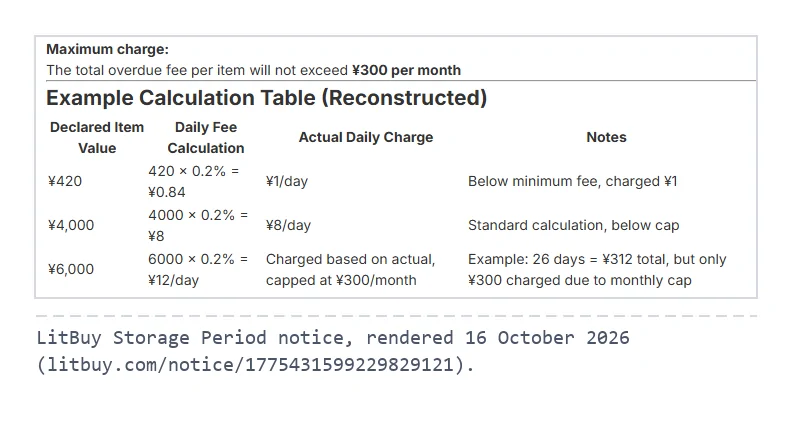
The policy's Fee Standard section has three lines. The daily fee equals the actual paid item price times 0.2%. The minimum charge is ¥1 per item per day, and if the calculated fee is less than ¥1, ¥1 is charged. The maximum is that the total overdue fee per item will not exceed ¥300 per month.
Under it is a table headed "Example Calculation Table (Reconstructed)" with three rows: ¥420, ¥4,000 and ¥6,000. The crop beside this text is LitBuy's own page as it rendered on 16 October 2026.
Fees are calculated daily and settled in yuan (CNY), whatever currency you top up with.
Floor
Paid price under ¥500. The formula gives less than ¥1, so the charge is ¥1 a day.
0.2% of the price
¥500 to ¥5,000. The charge is the formula: price times 0.2%, every day.
Ceiling
Above ¥5,000. The formula runs until the item has paid ¥300 in the month, then stops for that month.
Below five hundred yuan, one yuan a day
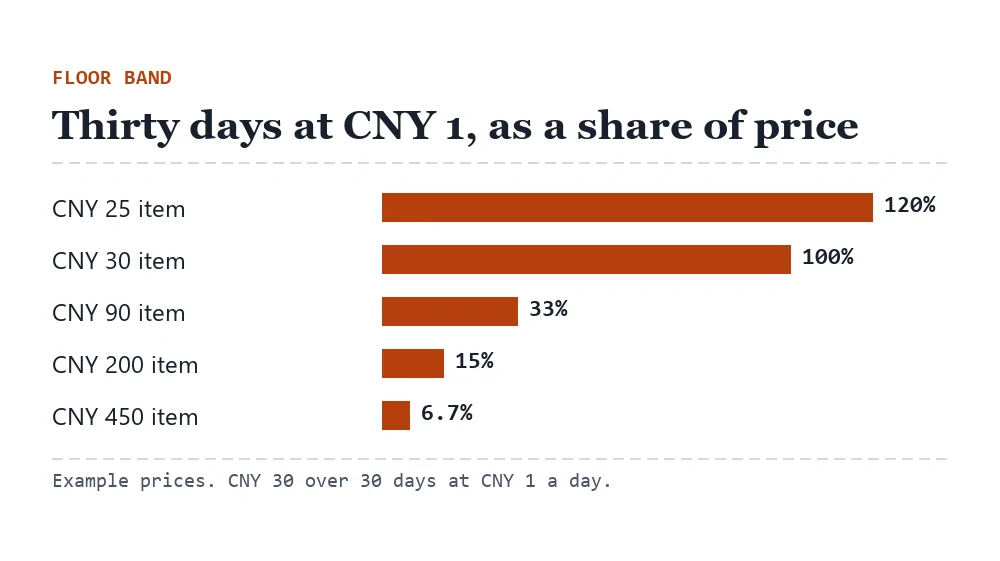
0.2% of ¥500 is exactly ¥1, so every item below ¥500 pays the floor. A ¥450 hoodie and a ¥25 keyring pay the same ¥1 each day.
Measured against price, the floor is steep at the bottom. Thirty overdue days take 6.7% of a ¥450 item, 33% of a ¥90 chain, 100% of a ¥30 tee and more than the whole price of anything under ¥30.
That is arithmetic, not a judgement on the rule. A fixed minimum is common in storage pricing; what is unusual here is that it sits under a percentage, so the line between floor and formula falls at a price many everyday items never reach.
Five hundred to five thousand, the formula itself
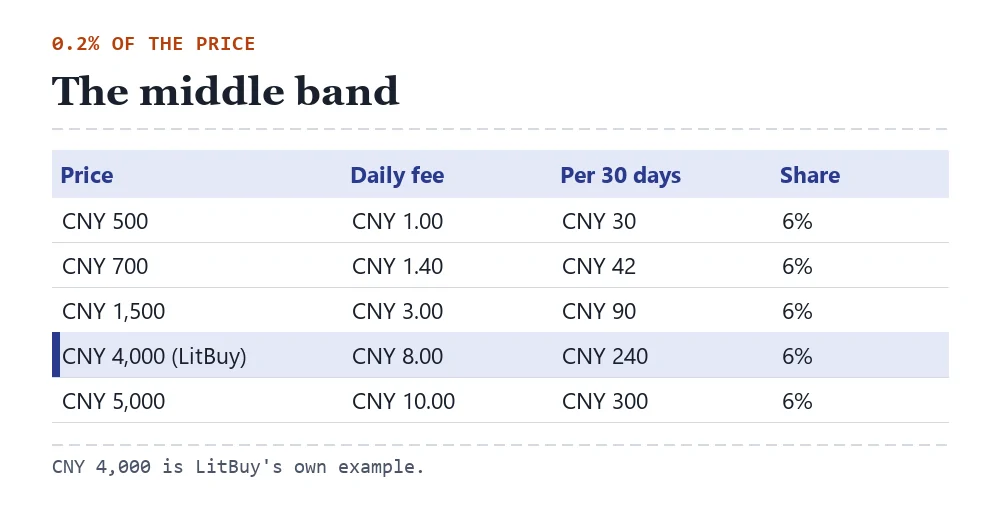
In the middle band the fee is the formula with nothing added: ¥1.40 a day for a ¥700 pair of sneakers, ¥8 a day for LitBuy's ¥4,000 example.
Here the share of the price is the same for every item: 0.2% a day, 6% per 30 days, 18% over three months. A more expensive item pays more yuan, but not a larger share.
At ¥5,000 the formula gives ¥10 a day, which is exactly ¥300 over 30 days. That is the top of the band: one yuan more and a 30-day stretch would go over the ceiling.
Above five thousand, the ceiling arrives early
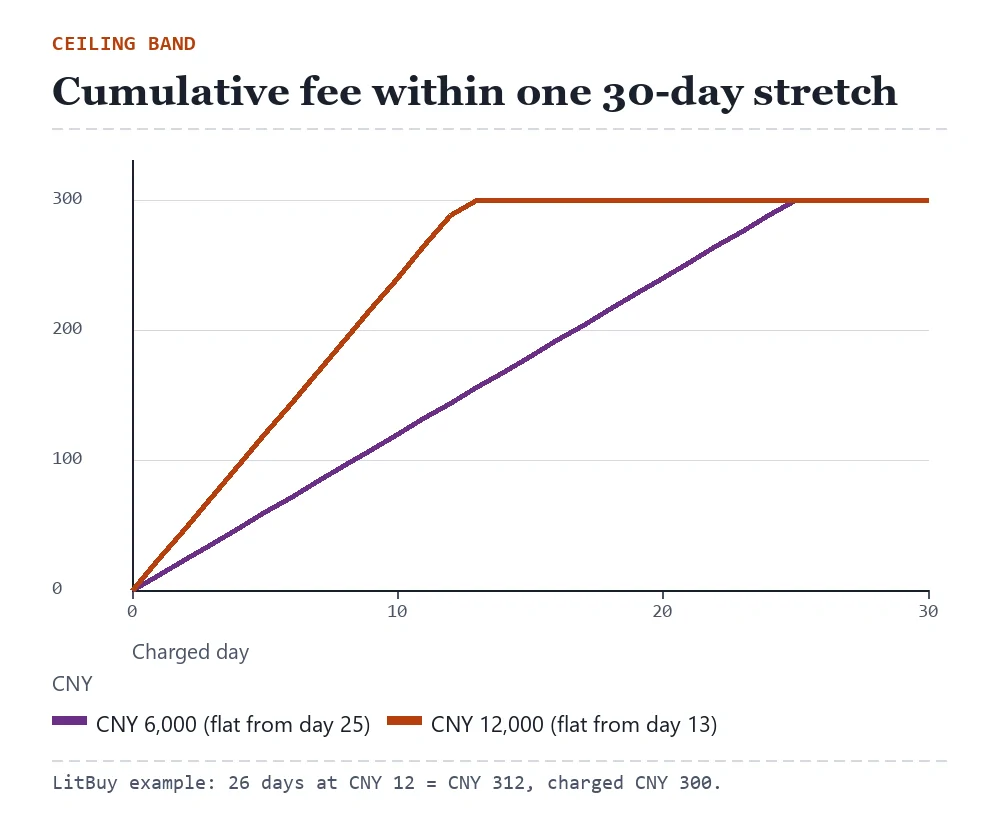
A ¥6,000 item pays ¥12 a day. After 25 days it has paid ¥300, and the ceiling holds it there for the rest of the month. LitBuy's example says the same thing from the other side: 26 days would be ¥312, but only ¥300 is charged.
The higher the price, the earlier the ceiling: day 19 for ¥8,000, day 13 for ¥12,000, day 8 for ¥20,000. Past that point, extra days in the same month add nothing.
Measured against price, these items pay the smallest share of all bands: ¥300 a month is 5% of ¥6,000 and 1.5% of ¥20,000.
The share of price, across every price
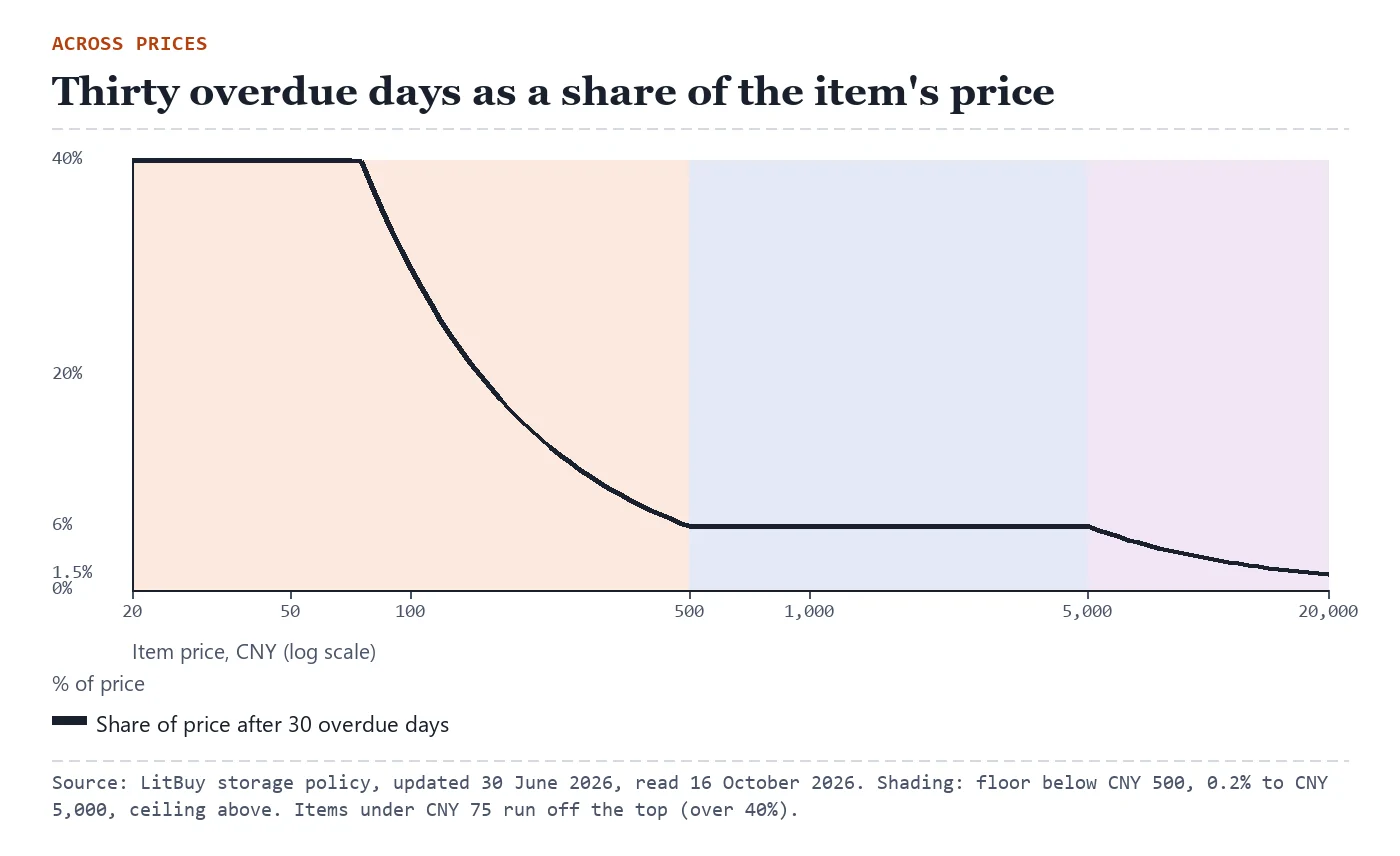
Put the three bands on one chart and the shape of the rule appears. The share of an item's price taken by 30 overdue days falls steeply through the floor band, runs flat at 6% through the middle band, and falls again once the ceiling takes over.
So for 30 days of waiting, the lowest-priced items pay the largest share and the dearest items the smallest, with a long flat stretch in between.
The chart uses a log scale for price so that ¥20 and ¥20,000 fit on the same line. The meter gives the exact figure for any price you type.
LitBuy's three examples, line by line
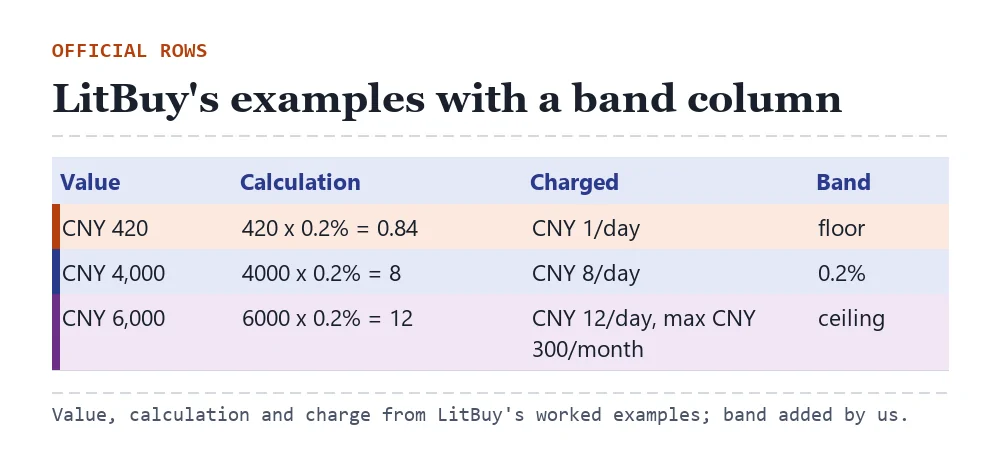
The table in LitBuy's policy has four columns: declared item value, daily fee calculation, actual daily charge and notes. We copy its rows and add the band each falls in.
Row one, ¥420: 420 times 0.2% is ¥0.84, below the minimum, so ¥1. Row two, ¥4,000: ¥8, standard calculation, below the cap. Row three, ¥6,000: ¥12 a day, charged on actual and capped at ¥300 a month, with the 26-day example.
LitBuy's examples label the price as declared item value, while the formula line above them says actual paid item price. The fee-base page deals with that.
What the bands leave out
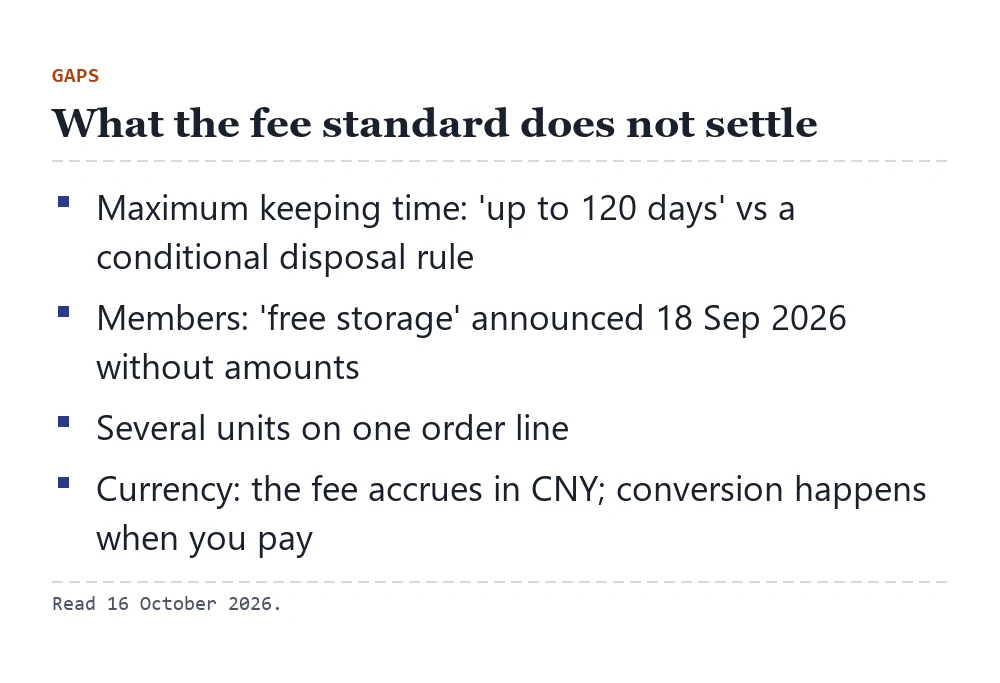
- They say nothing about how long an item may be kept. The policy opens with "up to 120 days" but its disposal clause is conditional; see the policy page
- They may not be the last word for members. LitBuy's 18 September 2026 membership announcement lists "free storage" among the benefits of higher levels and of Lit Prime but gives no amounts, and the storage policy does not mention membership. If your account has a level, check the fee LitBuy shows you.
- They apply per item, not per parcel or per order. Two units on one order line are not addressed.
- They are in yuan. If you top up in another currency, the conversion happens when you pay, not when the fee accrues.
Next receipt in this set: Storage policy, clause by clause