
Per-item overdue meter for LitBuy warehouse storage
One line per K-numbered item. Type the price you paid and the date it was stocked; the meter does LitBuy's storage arithmetic for each line and sorts the list by which item suffers most from waiting.
The meter
| Item | Price (CNY) | Stocked on | Price basis | Remove |
|---|
The meter needs JavaScript. Without it, use the worked examples on this page.
The official examples, run through the meter
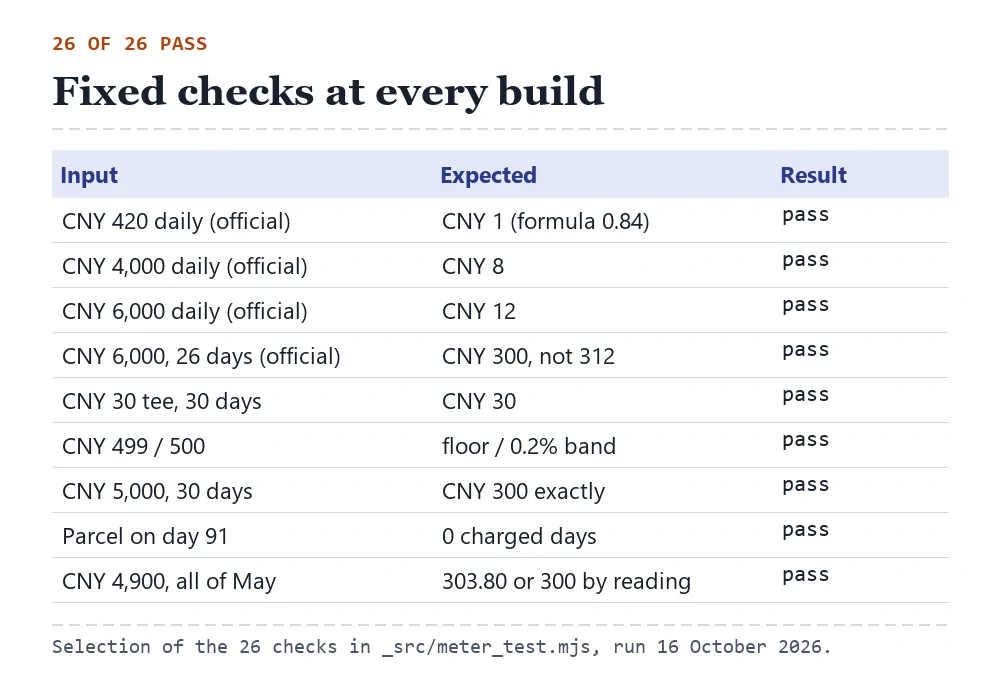
Before the meter went on this page we fed it LitBuy's own three examples. ¥420 gives a formula fee of ¥0.84 and a charge of ¥1. ¥4,000 gives ¥8 a day. ¥6,000 gives ¥12 a day, and 26 charged days add up to ¥312, which the meter cuts to ¥300, exactly as LitBuy's table does.
We also check the edges: ¥499 is on the floor and ¥500 is not; ¥5,000 pays exactly ¥300 in 30 days and never goes over; a parcel created on day 91 means nothing is charged. Twenty-six fixed checks run every time the site is built, and the build fails if one breaks.
The test file and its output are listed on the about page
Using the meter, line by line
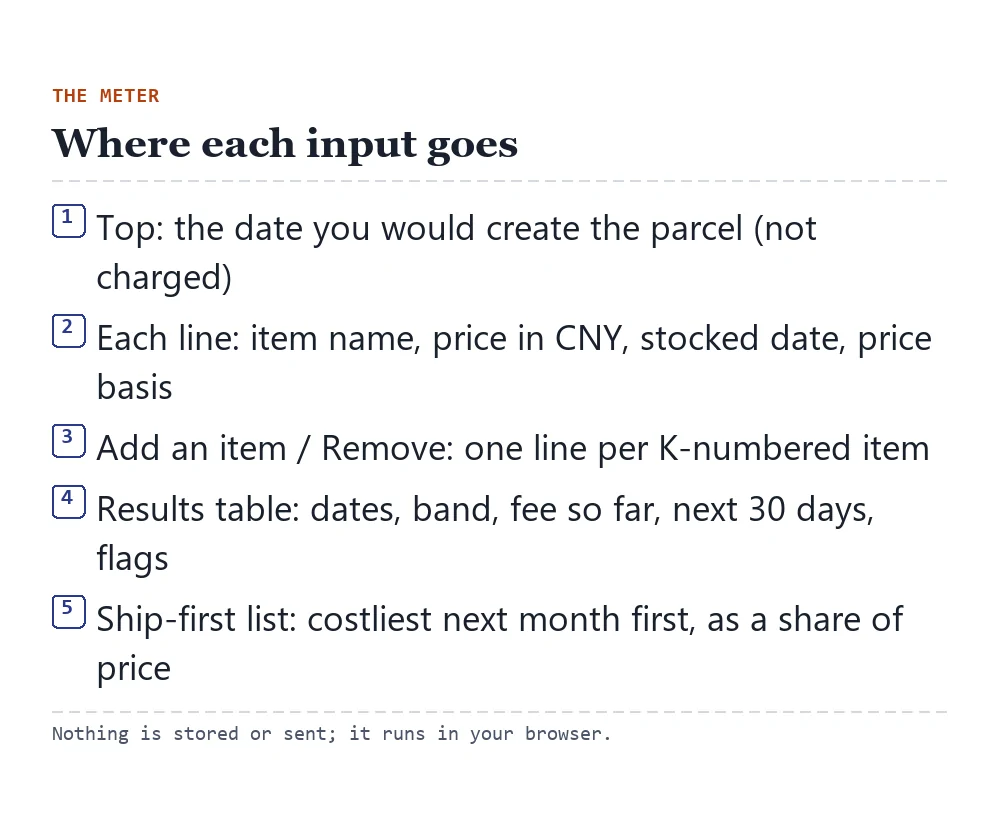
Here is how to use the tool, from the top of the panel down:
- Set the date you plan to create the parcel. It defaults to today. That day itself is not charged, because LitBuy stops counting on the day the parcel order is created.
- For each item, type a name you will recognise, the price you paid in yuan, and the date it was stocked (the date shown when it became Stored).
- If the item came in through forwarding, set the basis to declared value and type the value you declared; forwarded goods have no purchase price.
- Read the results table, then the ship-first list under it. Change the date to see what waiting another week or month would do.
- Remove lines you have already shipped. Nothing is saved; reload to start again.
What each result column says
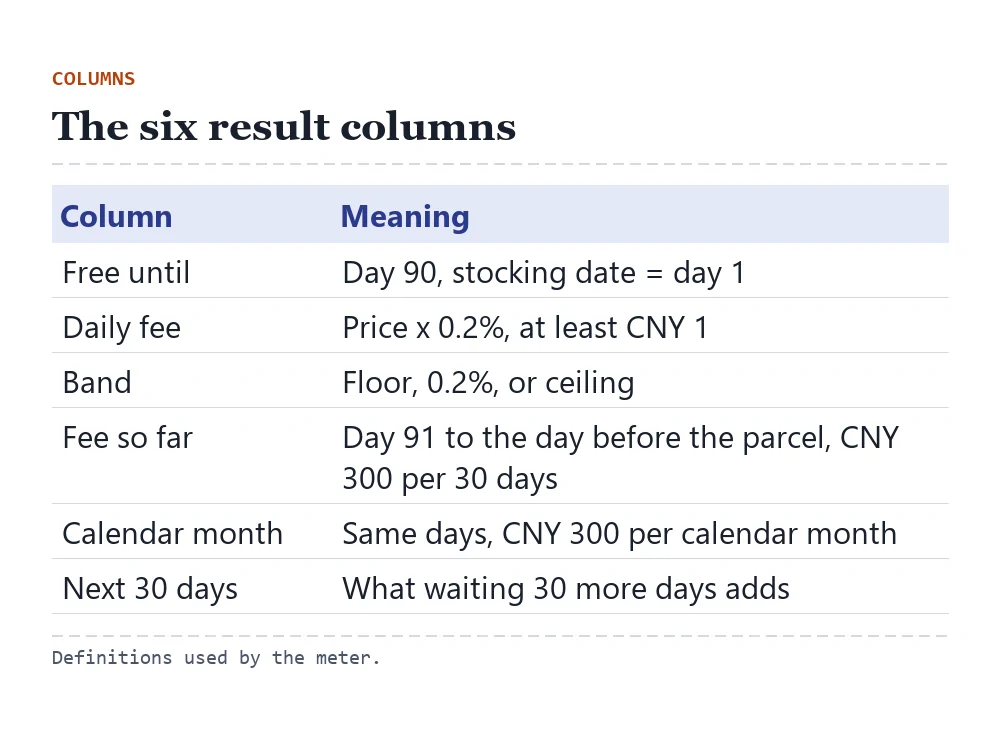
- Free until: the 90th calendar day, counting the stocking date as day 1.
- Daily fee: the price times 0.2%, raised to ¥1 when the formula gives less. The formula figure is shown underneath when the floor applies.
- Band: floor, 0.2% of the price, or ceiling (more than ¥300 per 30 days at the formula rate).
- Fee so far: everything charged from day 91 up to the day before your parcel date, with the ¥300 limit applied per 30-day stretch.
- If month = calendar month: the same days with the limit applied per calendar month instead.
- Next 30 days: what 30 more days of waiting would add, and that amount as a share of the price.
Two ways to read per month
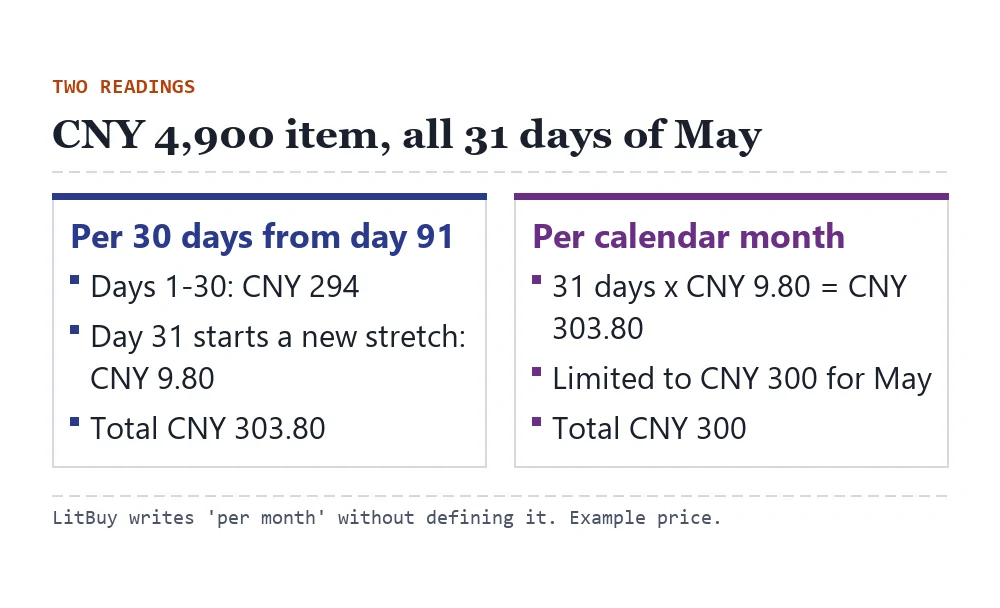
LitBuy's policy says the overdue fee per item "will not exceed ¥300 per month". It does not say whether a month is a calendar month or a run of 30 days counted from day 91, and the worked example (26 days, ¥312 cut to ¥300) fits both readings.
The difference only shows for items above roughly ¥4,840 whose overdue days fall across a 31-day month, or whose charged days straddle two calendar months. A ¥4,900 item charged for all 31 days of May pays ¥303.80 under the 30-day reading and ¥300 under the calendar reading.
The meter shows both. Your LitBuy bill, visible under My Warehouse or Order Details, is the figure that counts; LitBuy has not published which reading it uses.
What the meter assumes
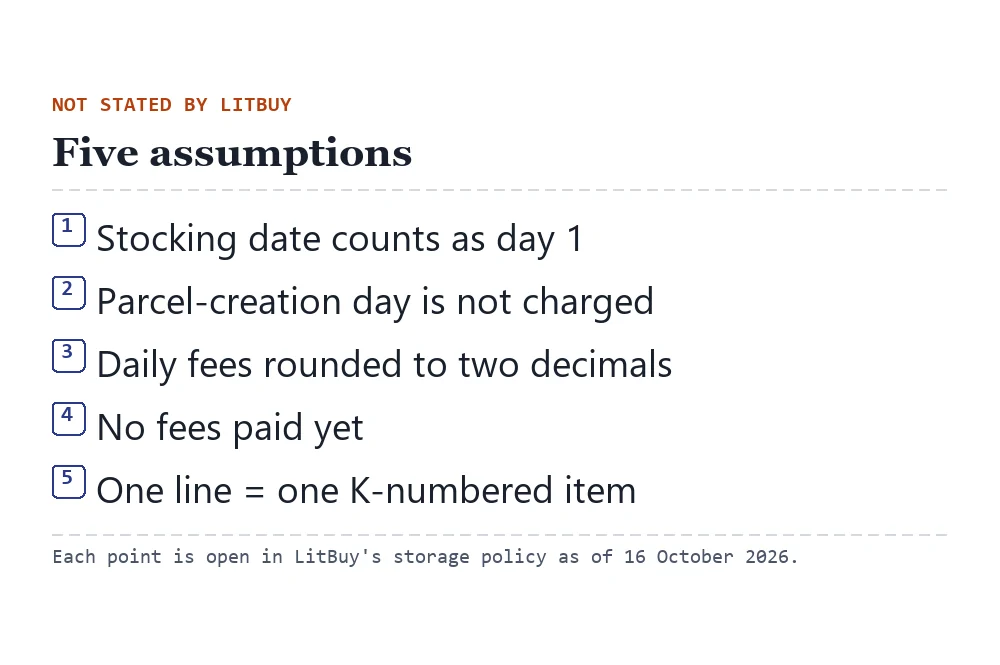
- The stocking date is day 1 and day 91 is the first charged day. LitBuy says the free period "lasts until 23:59:59 on the 90th day" but does not say how the stocking day itself is counted.
- The parcel-creation day is not charged. If LitBuy charges it, add one daily fee per item.
- Daily fees are rounded to the fen (two decimals). LitBuy does not describe its rounding.
- No fees have been paid. The disposal flags read the policy as if the whole bill is still open.
- One line is one K-numbered item. If a single order line holds several units, LitBuy's policy does not say whether each unit is an item.
Flags on a line
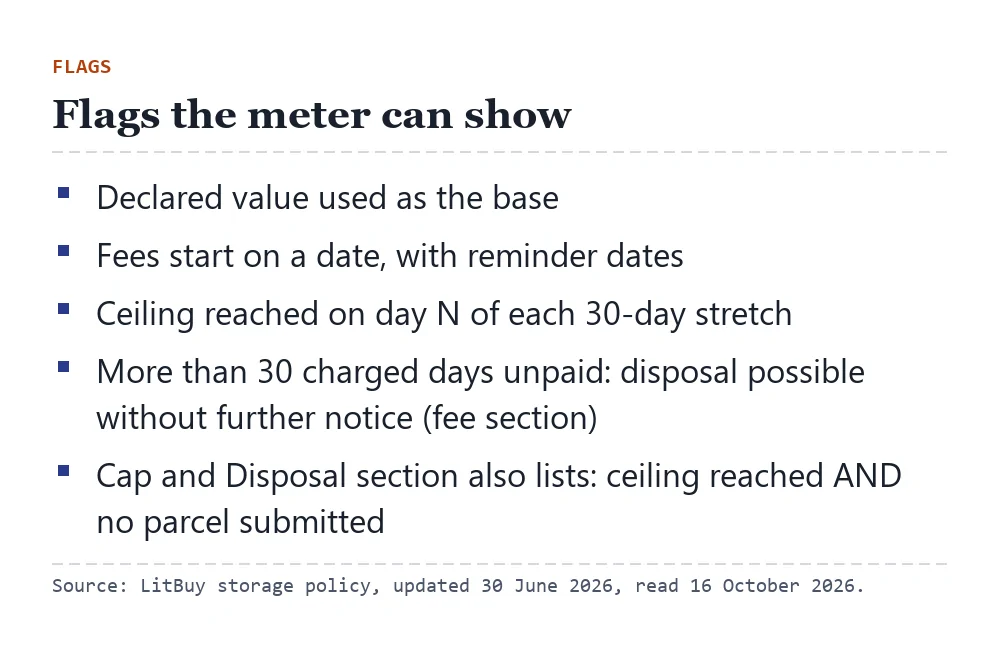
A line can carry up to four flags. The first says the base is a declared value. The second gives the date fees start and LitBuy's reminder dates if the item is still free.
The third appears for ceiling-band items and says on which day of each 30-day stretch the ¥300 limit is reached. The fourth appears when more than 30 charged days are open: LitBuy's policy says fees unpaid for more than 30 days lead to disposal without further notice.
That fourth flag also says when the item has not reached the monthly ceiling, because the policy's Cap and Disposal section lists three conditions together: the ceiling reached, fees unpaid over 30 days, and no parcel submitted. The two sentences do not match, and we show both rather than choose.
Forwarded items on the meter
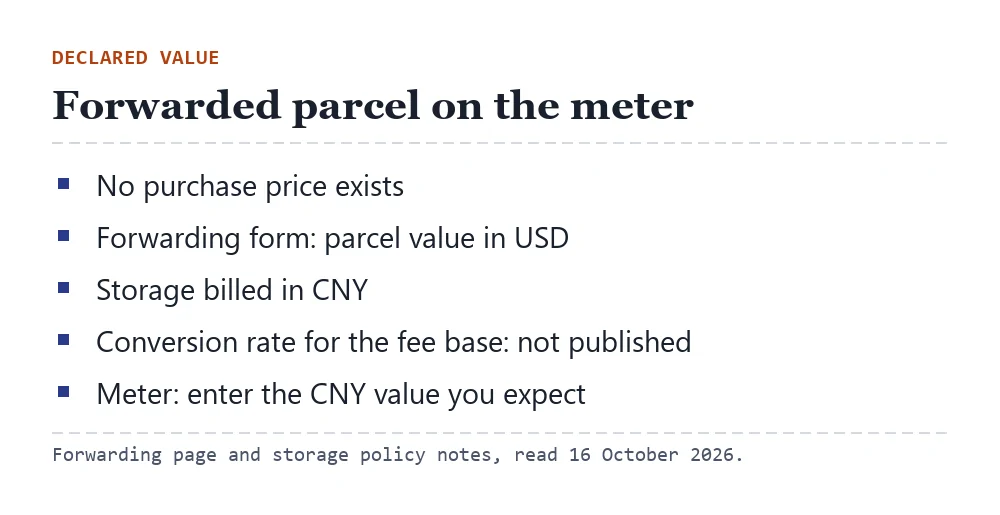
Items you send to the warehouse yourself through forwarding were never bought through LitBuy, so they have no paid price. LitBuy's policy, in its Important Notes, says overdue fees are based on "Declared value at inbound OR Actual paid item price".
The forwarding form asks for a parcel value in US dollars, while storage is billed in yuan. LitBuy does not say which exchange rate turns one into the other, so type the yuan figure you expect it to use and treat the result as approximate.
Next receipt in this set: Floor, percentage and ceiling