
Deciding which parked LitBuy items leave first
When your warehouse holds a mix of cheap and dear items, the order you ship them in changes the storage bill. The rule of thumb is short; the reasons are below.
Sort by what another month costs
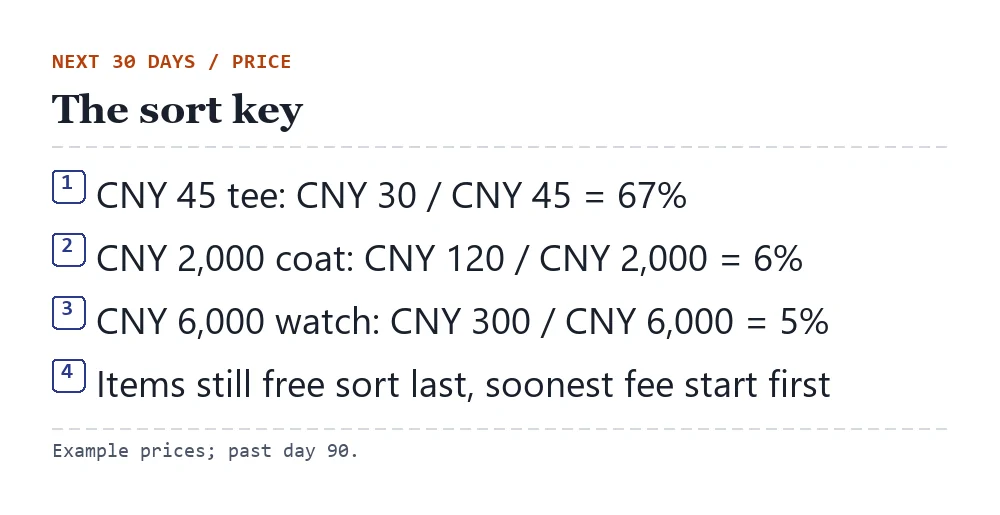
For each item, take what 30 more days in the warehouse would add, and divide by the item's price. The item with the largest share is the one that loses most by waiting.
Past day 90, floor-band items almost always come out on top: ¥30 a month is a large share of a ¥60 cap and a small share of a ¥2,000 coat. Items still inside their free period come last, sorted by how soon their fees start.
Why a share rather than yuan? Because the question is whether the item is still worth having at the end. A ¥300 month on a ¥6,000 watch is 5%; ¥30 on a ¥45 tee is two-thirds.
A five-item warehouse, sorted
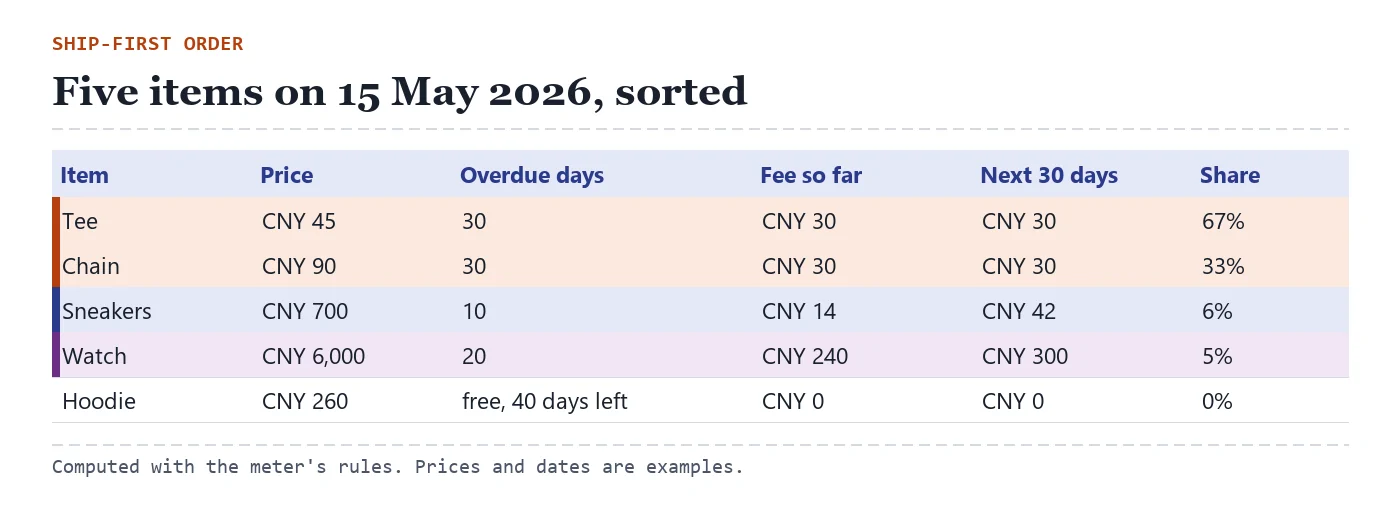
Five items stocked on different dates, checked on 15 May 2026: a ¥45 tee and a ¥90 chain both 30 days past day 90, a ¥700 pair of sneakers 10 days past, a ¥6,000 watch 20 days past, and a ¥260 hoodie still inside its free period with 40 days to go.
The meter puts the tee first (another month adds 67% of its price), then the chain (33%), the sneakers (6%), the watch (5%, because the ceiling holds each 30-day stretch to ¥300) and the hoodie last.
The order is not a recommendation to ship each item alone. It tells you which items should be in the next parcel you send, whatever else you add.
Paying for some items, leaving others
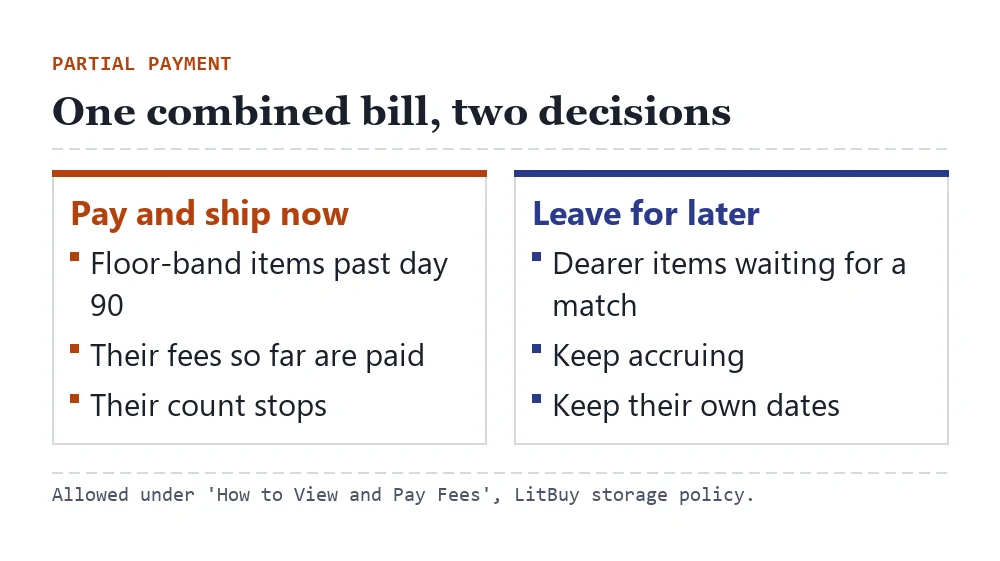
LitBuy combines the bills of several overdue items but lets you pay for some first and ship them, while the others keep accruing. Nothing in the policy forces you to settle everything at once.
That means a small, early parcel of floor-band items is possible without touching the dearer items you are still waiting to pair with something. Whether a small parcel makes sense depends on shipping, which is priced per parcel by route and weight; the freight estimator gives a dated figure for your destination.
Fees already incurred on the items you ship must be paid. The ones left behind keep their own clocks.
The parcel order is the stop button
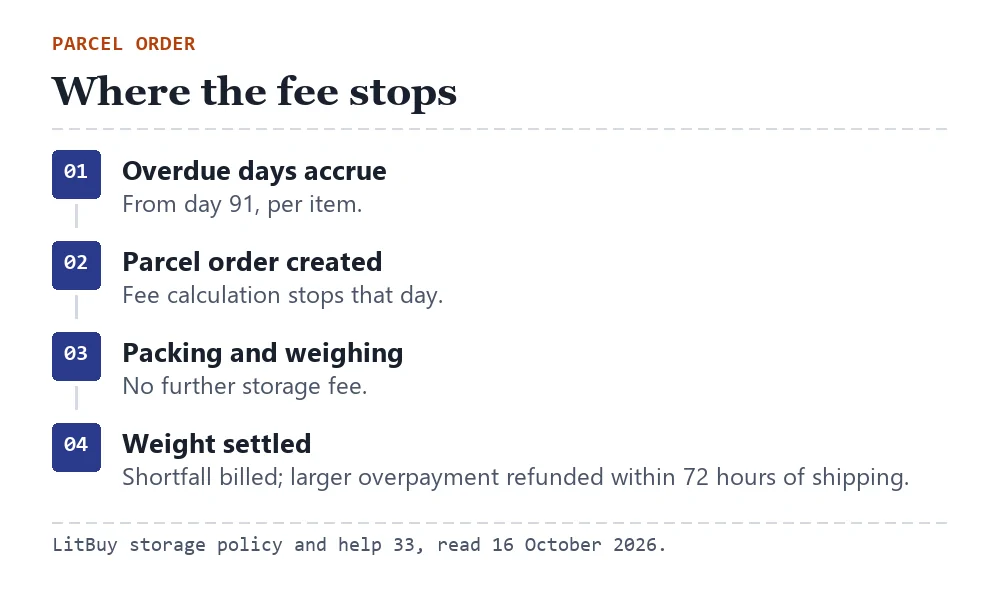
Fee calculation stops on the day the parcel order is created. You do not have to wait for packing, weighing or dispatch.
So the date that matters is the day you submit, not the day the parcel leaves. If you are a few days from a fee start, or from a 30-day unpaid mark, submitting the parcel is what freezes the count.
After submission LitBuy packs and weighs the parcel; if the actual weight exceeds the estimate you are asked to pay the difference, and overpayment by more than one billing unit is refunded to your wallet within 72 hours after shipping.
Items that cannot share a parcel
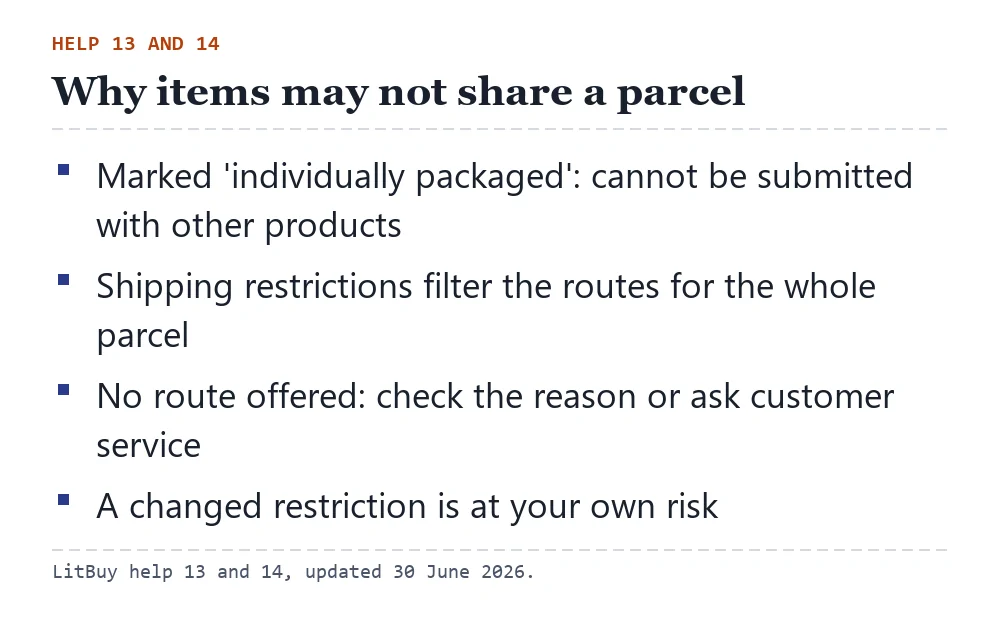
Some items cannot go in the same parcel as others. LitBuy's help says items marked "individually packaged" cannot be submitted together with other products, and items with shipping restrictions narrow the routes available to every item they are grouped with.
When no route is offered at all, LitBuy suggests checking the restriction reason or asking customer service; it may change a restriction if the goods allow, with the risk on you.
Plan for this when you sort: a restricted item at the top of your ship-first list may need its own parcel and route.
Watching the dates without the meter
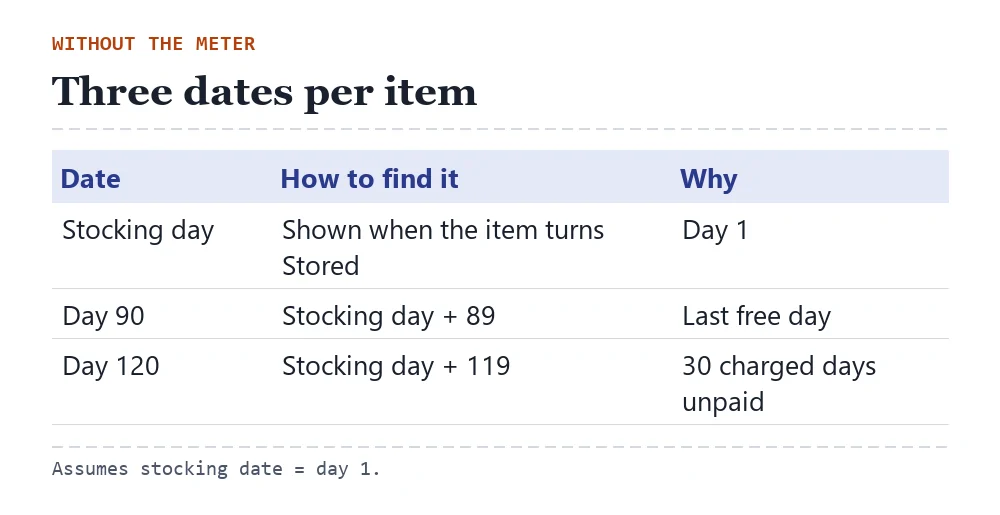
If you would rather not use the meter, three dates per item are enough: the stocking date, day 90 (the stocking date plus 89 days) and day 120, when 30 days of fees would be unpaid if you have not paid anything.
LitBuy's reminders cover the first two. Put the third in your own calendar, because the policy says disposal can happen without further notice.
For items under ¥500, add one more thought: each overdue day costs ¥1 regardless of price, so the decision is simply whether the item is still worth its price plus the days so far.
Next receipt in this set: Paid price or declared value