
LitBuy Spreadsheet categories, with the storage arithmetic on each card
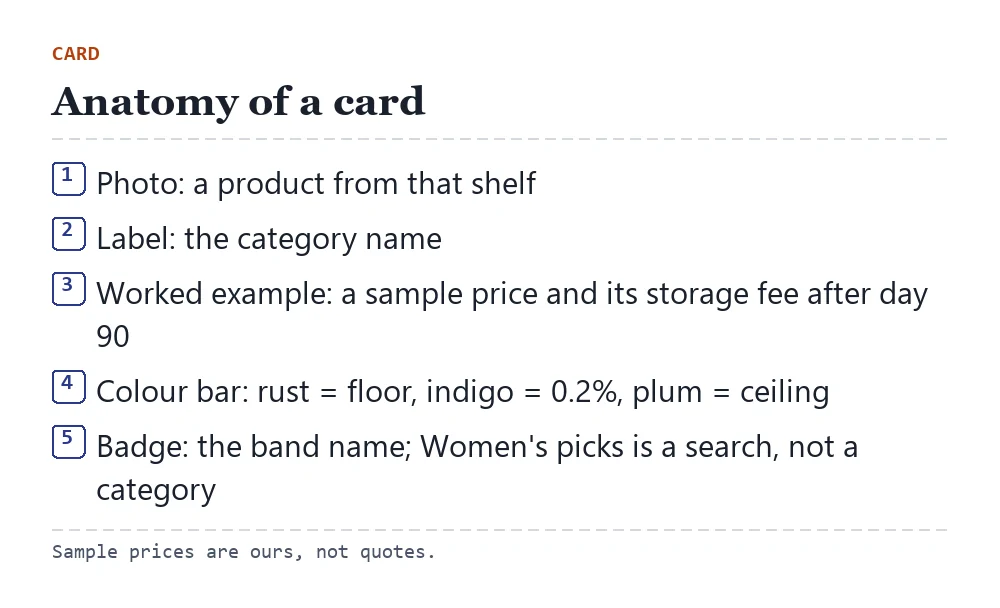
Sixteen product shelves. Each card shows what a sample-priced item in that shelf would pay per day once its 90 free days are over.
Sixteen shelves, sorted by sample price
The cards run from the lowest sample price to the highest, so the first eleven sit on the one-yuan floor, four follow the 0.2% formula, and the last meets the monthly ceiling. The samples are ours. Your item's real band depends on the price you actually pay.
 HatsExample at ¥60: ¥1 a day, so 30 overdue days cost 50% of the priceFloor band
 T-shirtsExample at ¥45: ¥1 a day, so 30 overdue days cost 67% of the priceFloor band
 JewelleryExample at ¥90: ¥1 a day, so 30 overdue days cost 33% of the priceFloor band
 BeltsExample at ¥120: ¥1 a day, so 30 overdue days cost 25% of the priceFloor band
 EyewearExample at ¥150: ¥1 a day, so 30 overdue days cost 20% of the priceFloor band
 SweatpantsExample at ¥160: ¥1 a day, so 30 overdue days cost 19% of the priceFloor band
 Sports jerseysExample at ¥180: ¥1 a day, so 30 overdue days cost 17% of the priceFloor band
 WomenswearExample at ¥220: ¥1 a day, so 30 overdue days cost 14% of the priceFloor band · search
 HoodiesExample at ¥260: ¥1 a day, so 30 overdue days cost 12% of the priceFloor band
 JeansExample at ¥300: ¥1 a day, so 30 overdue days cost 10% of the priceFloor band
 PerfumeExample at ¥380: ¥1 a day, so 30 overdue days cost 8% of the priceFloor band
 BagsExample at ¥650: ¥1.30 a day, 6% of the price per 30 days0.2% band
 SneakersExample at ¥700: ¥1.40 a day, 6% of the price per 30 days0.2% band
 OuterwearExample at ¥900: ¥1.80 a day, 6% of the price per 30 days0.2% band
 ElectronicsExample at ¥2,400: ¥4.80 a day, 6% of the price per 30 days0.2% band
 WatchesExample at ¥5,800: ¥11.60 a day until ¥300 is reached in a monthCeiling band
A product catalogue, not a document
The word spreadsheet stuck to these catalogues because the first ones were shared lists of product links. What you browse now is a set of product cards with photos, grouped into categories, each linking to marketplace listings you can buy through an agent.
This catalogue keeps that shape and adds one thing per card: the storage band a sample price falls into. That number is there to make you think about the warehouse before you add, not to tell you what items in that category cost.
Nothing on the cards is a LitBuy price or a seller's price. Prices in yuan only become real on the listing page and, after purchase, in your LitBuy order.
How a card becomes a stored item
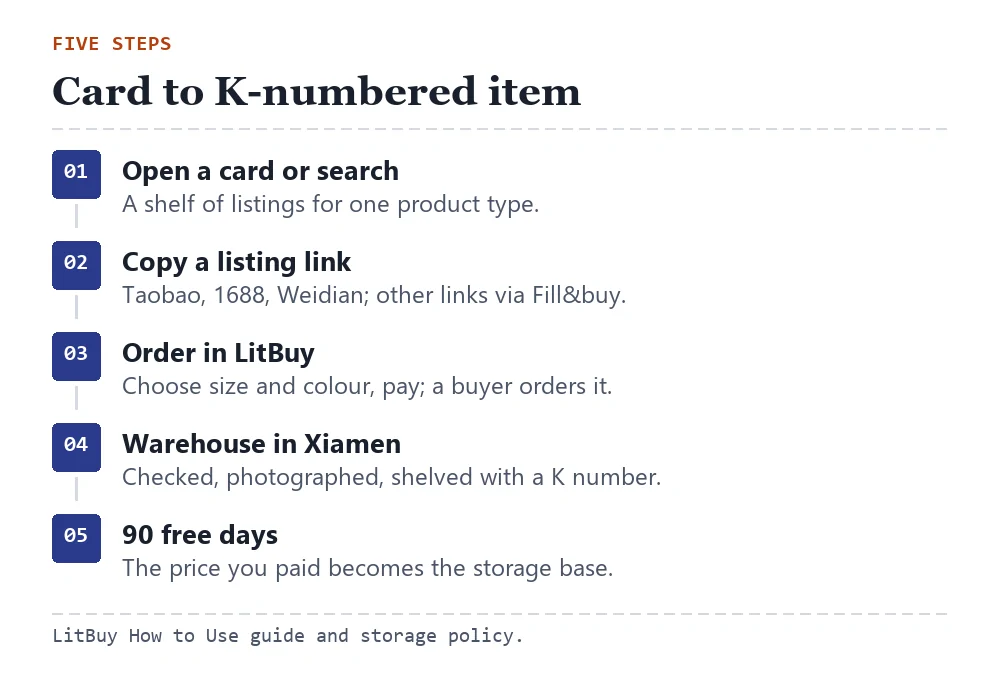
- Open a card or search. You land on a shelf of listings for that type of product.
- Open a listing and copy its link (Taobao, 1688 or Weidian work in LitBuy's main search; other links can go through Fill&buy).
- Paste it into LitBuy, choose size and colour, and pay. A buyer orders it from the seller.
- The seller ships to the Xiamen warehouse. The item is checked, photographed and shelved with a K-numbered order line.
- From the stocking date the item has 90 free calendar days. Its price paid is what the storage formula will use.
A saved link is not yet a stored item
The catalogue helps you discover a product; open the seller page to select the exact size, colour and quantity. Check the price for that option and save the measurements and material description you relied on. Two cards with the same photograph may describe different versions. Copy the original listing into the agent’s purchase process, using the manual form only when appropriate and with verified details.
Follow the order through purchase and domestic dispatch. The warehouse storage record starts at a different event from finding the link, topping up or paying the seller order. Keep the stored timestamp for each item rather than assigning the whole basket one date. That distinction matters when purchases from different shops arrive days apart.
Reading the sample on each card
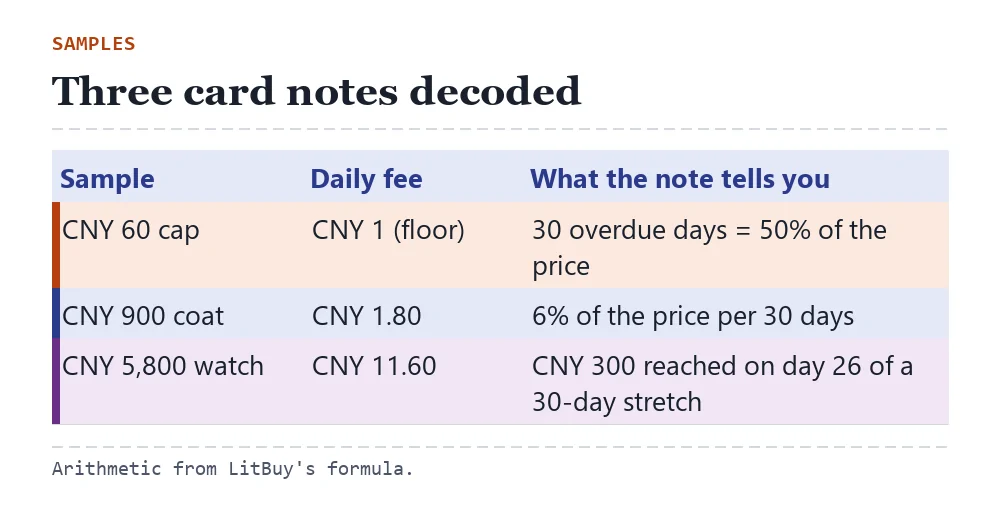
Each note says: a sample price, the daily fee that price would pay after day 90, and either the share of the price that 30 overdue days would take, or when the monthly ceiling would bite.
Below ¥500 the note always says ¥1 a day, because 0.2% of anything under ¥500 is under a yuan. The percentage changes with the price: 50% for a ¥60 cap, 10% for ¥300 denim.
Between ¥500 and ¥5,000 the share is fixed at 6% per 30 days, because the fee is simply 0.2% times 30. Above ¥5,000 the ¥300 limit takes over and the share falls again.
Small accessories meet the floor first
Caps, tees, chains, belts and sunglasses are often bought as add-ons, a few at a time, while waiting for a larger item. They are also the items most likely to cost under ¥500.
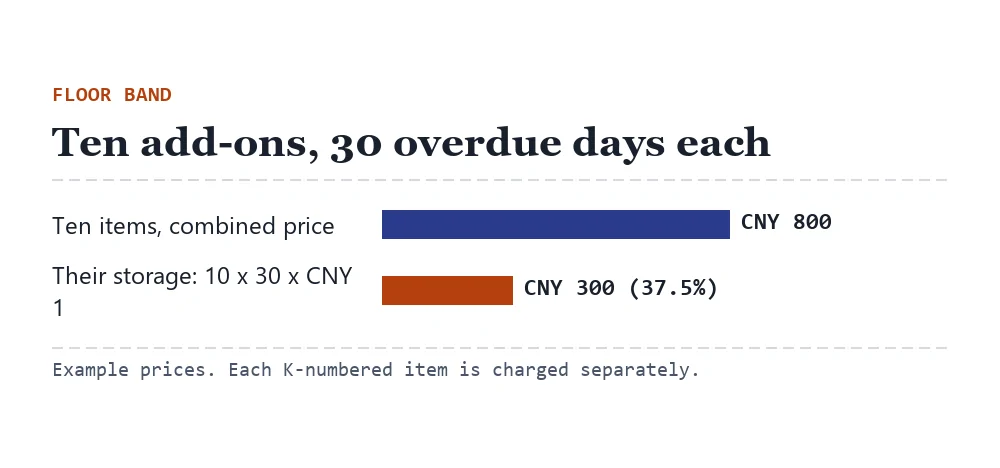
Ten small add-ons that each sit 30 days past day 90 run up ¥300 between them, whatever they cost. If the ten together cost ¥800, storage has added more than a third.
The meter lists each of them as its own line, because LitBuy charges each K-numbered item separately. Nothing in the policy groups small items into one charge.
Where the monthly ceiling matters
Only items above ¥5,000 reach the ¥300 ceiling within a 30-day stretch. In the catalogue that means a few watches, some electronics and the occasional designer bag.
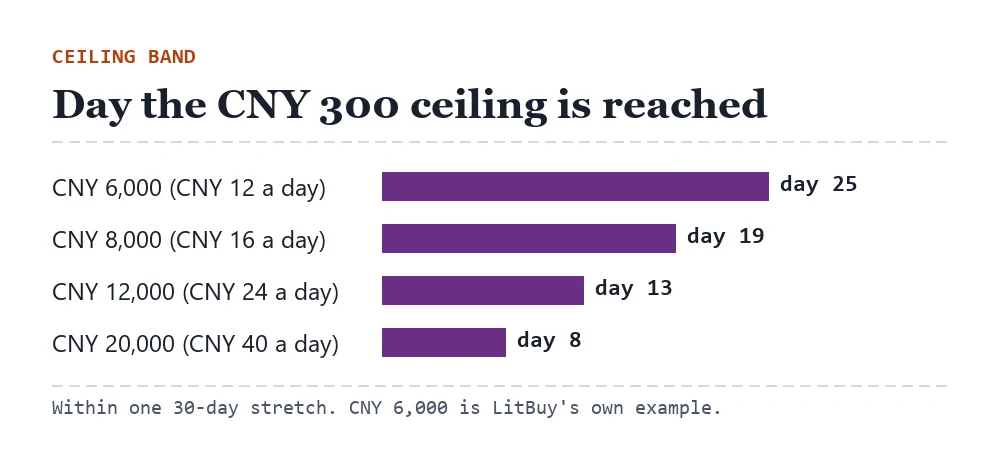
For a ¥6,000 item the ceiling is reached on the 25th charged day of each 30-day stretch; the remaining days that month cost nothing extra. For a ¥12,000 item it arrives on day 13.
The ceiling is a cap on the bill, not a reason to wait. Unpaid fees past 30 days can still lead to disposal, as the storage policy page explains.
Finding something with no card
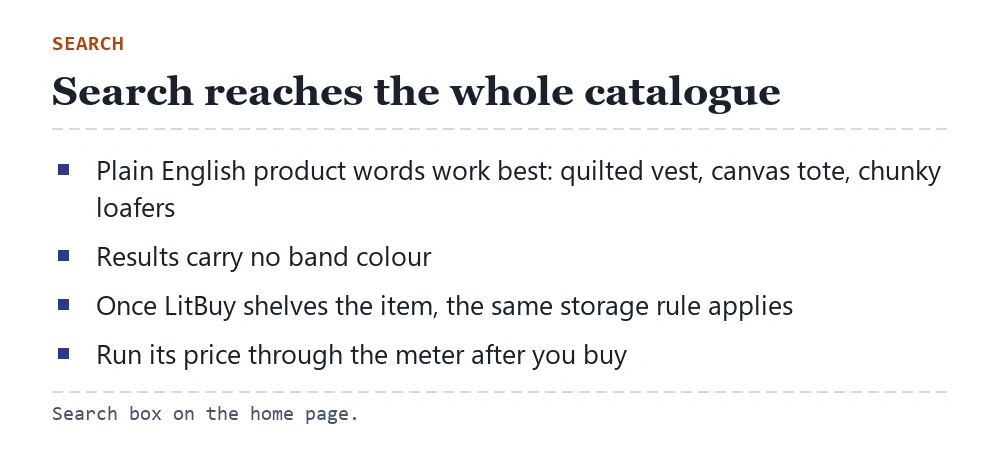
The search box on the home page looks across the whole catalogue, not just the sixteen shelves. Try plain product words in English: "quilted vest", "canvas tote", "chunky loafers".
Whatever you find, it enters the same storage rules as soon as LitBuy shelves it. A search result has no band colour on it; run its price through the meter once you have bought it.
Next receipt in this set: Per-item overdue meter