
LitBuy's storage policy, clause by clause
The footer page called Storage Period, last updated 30 June 2026, is the governing text for everything on this site. Here it is section by section, with what each part means in practice.
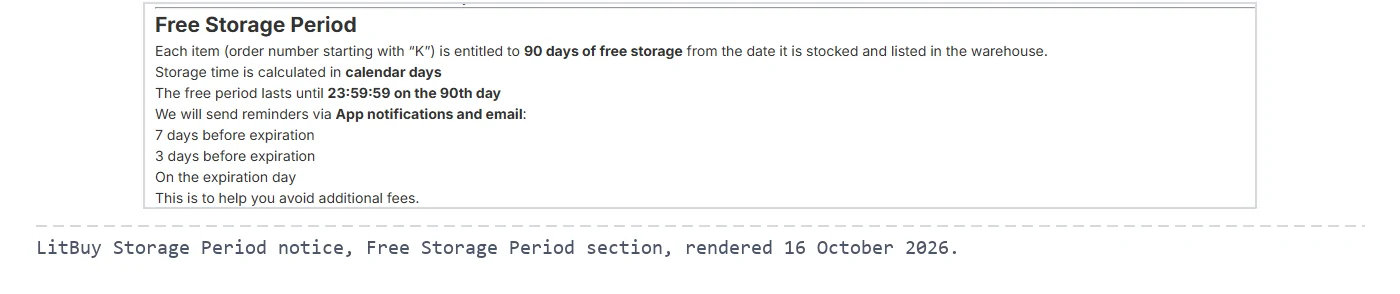
Ninety calendar days per K-numbered item
Each item whose order number starts with K is given 90 free days of storage, counted from the date it is stocked and listed in the warehouse. LitBuy counts calendar days, not working days, and the free period lasts until 23:59:59 on the 90th day.
The order status page describes the same moment from the other side: when an order turns Stored, "you have 90 days of free storage, please pay attention to the valid storage period and submit the parcel."
Two items bought on the same day can still have different clocks, because each one starts when it is shelved. A seller who ships late gives you a later free-until date for that item.
Reminders before and after the free period
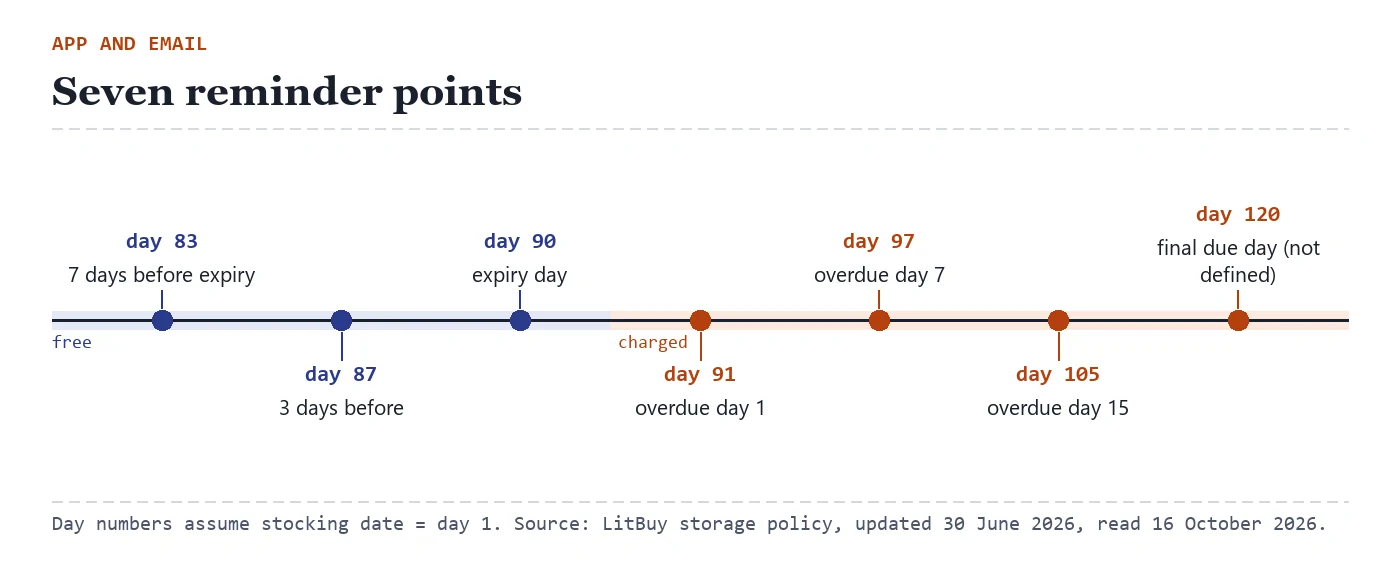
LitBuy says it sends app notifications and emails at three points before fees begin: seven days before the free period expires, three days before, and on the expiry day itself. Counting the stocking date as day 1, that is day 83, day 87 and day 90.
Once an item is overdue, reminders come on overdue day 1, day 7, day 15 and on the final due day. The policy does not define the final due day; read with the disposal sentence, it is most likely the end of the 30-day unpaid window.
Reminders go to the account's email and app. If you only use the website, the email is the one that reaches you.
When an item can be disposed of
The policy says it twice, in two forms. In the fee section: if overdue fees remain unpaid for more than 30 days, the item will be disposed of under the Terms of Service, without further notice.
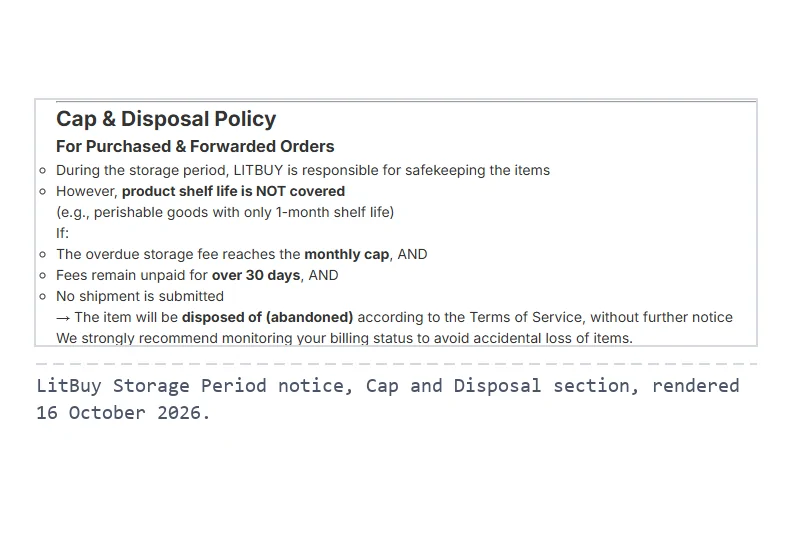
In the Cap and Disposal section, disposal follows when three things are all true: the overdue fee reaches the monthly cap, fees remain unpaid for over 30 days, and no shipment is submitted.
Items under ¥5,000 never reach ¥300 in a 30-day stretch, so under the stricter sentence they would not qualify; under the plainer one they would. LitBuy does not say which governs. The policy also opens with "up to 120 days", but that number is not a hard limit in either disposal sentence. Our advice is the boring one: do not leave a fee unpaid for 30 days.
Abnormal parcels: thirty days, no reminders
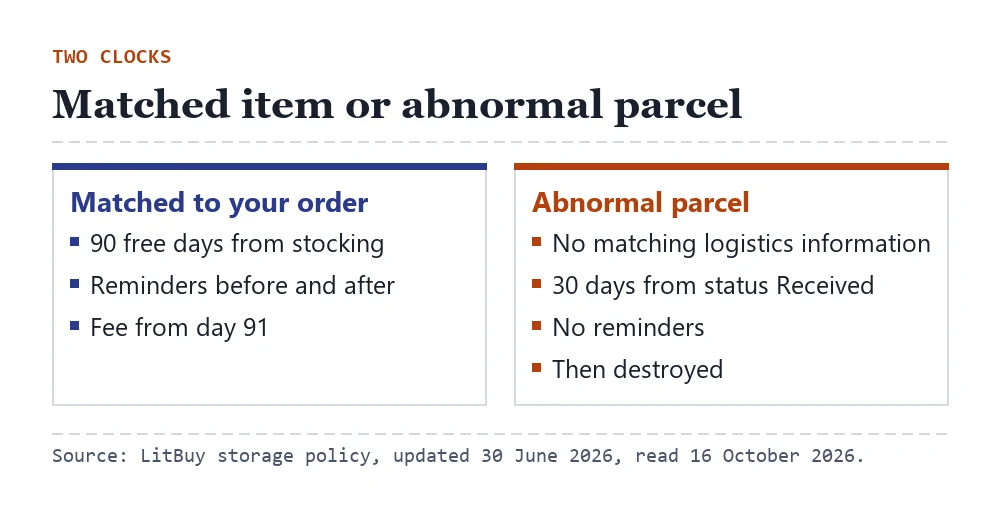
A separate rule covers parcels the warehouse receives without logistics information that matches an order, for example a forwarded parcel sent without a submitted forwarding form, or with a tracking number typed wrongly.
Those parcels get 30 days from the status Received. Because they cannot be matched to a user, no reminders are sent, and once the 30 days pass LitBuy treats the parcel as abandoned and destroys it.
If you forward your own parcels, submit the forwarding form with the right tracking number before the parcel arrives. That is the only protection the policy offers here.
Seeing the bill and stopping it
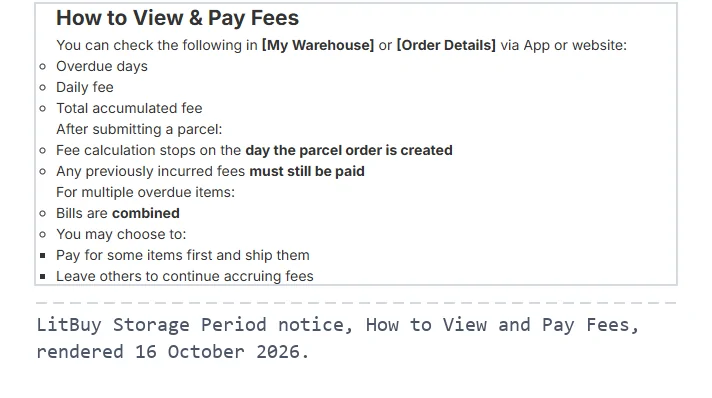
Overdue days, the daily fee and the total accumulated fee appear under My Warehouse or Order Details, in the app or on the website.
The fee stops on the day you create a parcel order containing the item. Fees already incurred must still be paid. Bills for several overdue items are combined, but you may pay for some items first and ship them, and leave the others to keep accruing.
That last point is what makes a ship-first order useful: you do not have to clear the whole warehouse at once. Choosing which items leave first
Safekeeping, but not shelf life
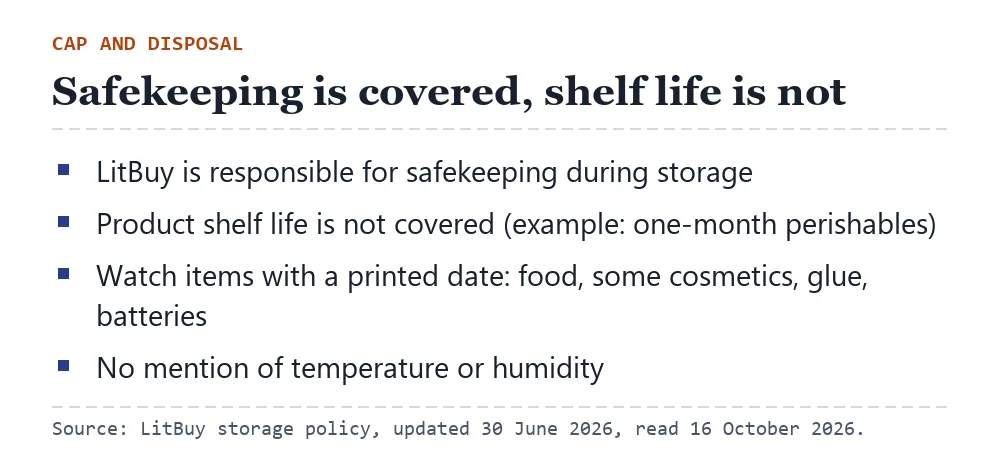
During the storage period LitBuy says it is responsible for safekeeping the items. The same paragraph adds that product shelf life is not covered, giving perishable goods with only a one-month shelf life as the example.
That matters for snacks, some cosmetics, glue, batteries and anything with a printed date. A free 90 days can be longer than the product's own life.
The policy says nothing about temperature or humidity. If an item is sensitive to either, ship it sooner rather than later, whatever the meter says about cost.
Where LitBuy's own pages disagree
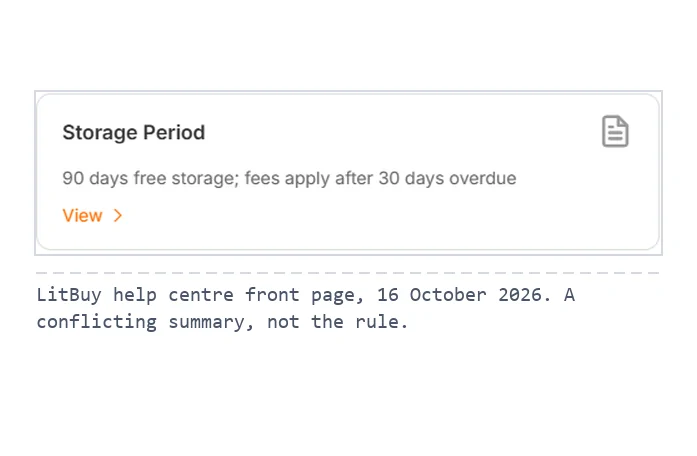
The help centre's front page has a card titled Storage Period that reads "90 days free storage; fees apply after 30 days overdue". The policy behind it says fees start on day 91 and that 30 days is the unpaid window before disposal. We follow the policy, which is dated and has the formula; the card appears to merge the two numbers.
The policy's own fee base is worded three ways: actual paid item price (formula), declared item value (example table), and declared value at inbound or actual paid price (notes). The formula line governs on this site.
The site's configuration also contains a storage unit price value of 10.00 that is not displayed anywhere on the site. It is not the rule users are billed under, and the meter ignores it.
Next receipt in this set: Which items leave first